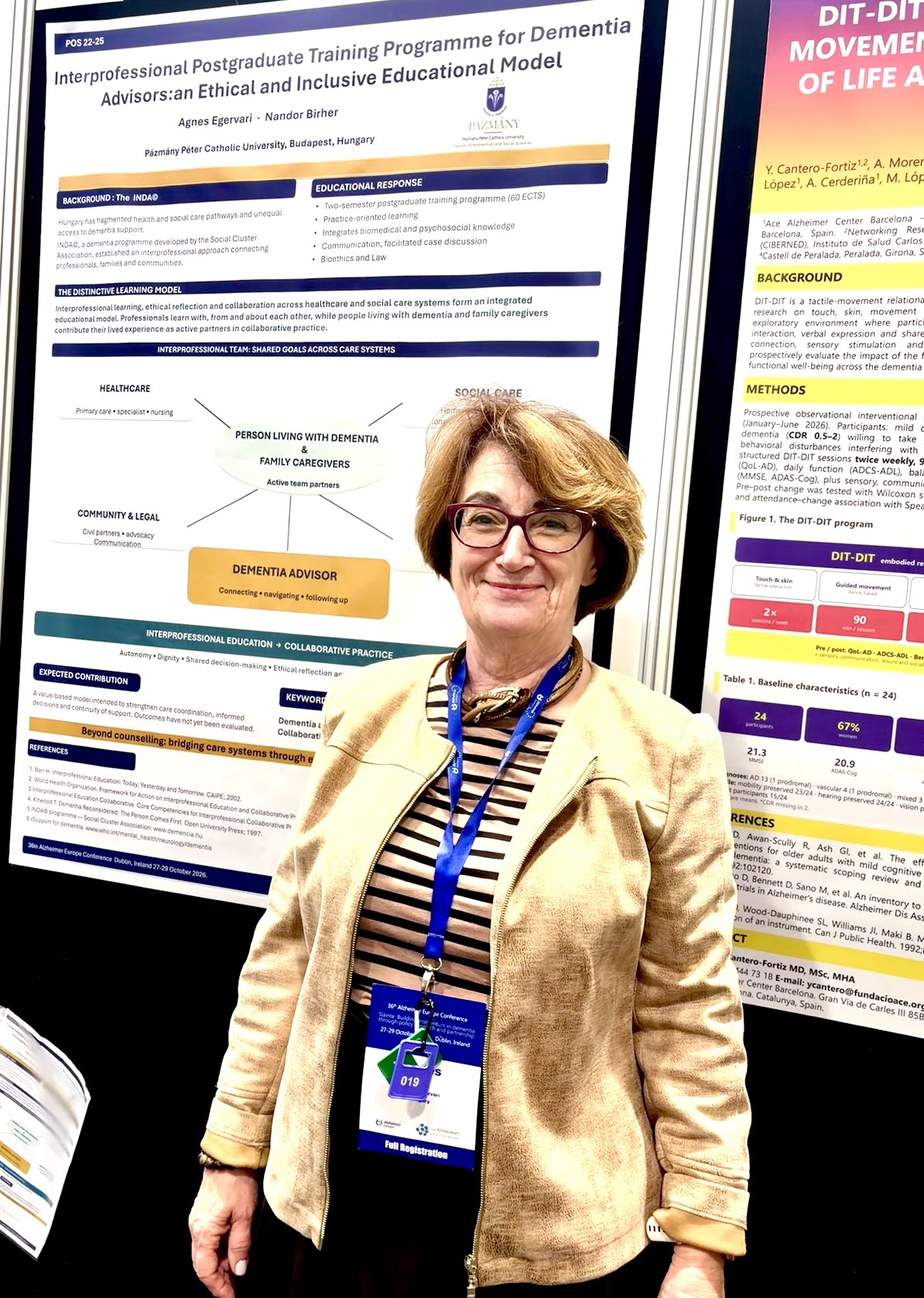
The newly launched Dementia Specialist Consultant programme at Pázmány Péter Catholic University (PPKE) was presented to an international audience at the 36th Alzheimer Europe Conference, held in Dublin from 27 to 29 October 2026. The programme was introduced through a scientific poster co-authored by its Director, Dr Ágnes Egervári, and the Dean of the Faculty of Humanities and Social Sciences, Dr Nándor Máté Birher. Dr Egervári presented the poster at the conference.
The event brought together more than 1,400 participants from 44 countries, including healthcare and social care professionals, family caregivers, and people living with dementia. Hungary was represented by three delegates from the Social Cluster (Szociális Klaszter). The programme comprised 50 parallel sessions, 207 oral presentations and 444 posters. Among these contributions, PPKE’s Faculty of Humanities and Social Sciences (BTK) presented its new postgraduate specialisation in dementia consultancy.
The two-semester programme, carrying 60 ECTS credits, prepares professionals to support people living with dementia and their families as they navigate the challenges of everyday life, care arrangements and complex decisions. Particular attention is given to ethical reflection and the protection of human dignity. This approach calls for close cooperation between healthcare and social care professionals, as well as the exchange of knowledge and practical experience across professional boundaries. Equally important, people living with dementia and their family members are recognised as active participants in this process. Their experiences, knowledge and perspectives must influence the development of support services and the decisions that affect their lives.
This person-centred approach was also evident throughout the Dublin conference. Researchers, healthcare and social care practitioners, civil society organisations, family caregivers and people living with dementia took part in discussions and shared their perspectives. Those directly affected by dementia had the opportunity to speak about their everyday experiences, the difficulties they encounter and the forms of support that make a genuine difference.
In his opening address, Irish Taoiseach Micheál Martin drew attention to the need for ageing societies to prepare for the growing issue of dementia. He stressed the importance of developing flexible services that can respond to changing needs, helping people maintain their independence and quality of life for as long as possible while providing appropriate support for their families and caregivers. He also highlighted the importance of exchanging knowledge across Europe and sharing responsibility for addressing the challenges posed by dementia.
The conference also marked the conclusion of a significant period in Alzheimer Europe’s history. In his keynote address, outgoing Executive Director Jean Georges reflected on three decades of leadership and highlighted the importance of long-term strategic partnerships and the active involvement of all stakeholders in shaping dementia policy and care.
The discussions in Dublin reinforced the importance of combining professional and clinical expertise with attentive, person-centred support and cooperation across disciplines. Dementia does not diminish a person's dignity or their place in society. The task of care is therefore not simply to address medical and practical needs, but also to respect individual autonomy, maintain social relationships and enable people living with dementia to remain involved in decisions about their own lives.